TL;DR: 2GB LPDDR4 Handheld POS Motherboard
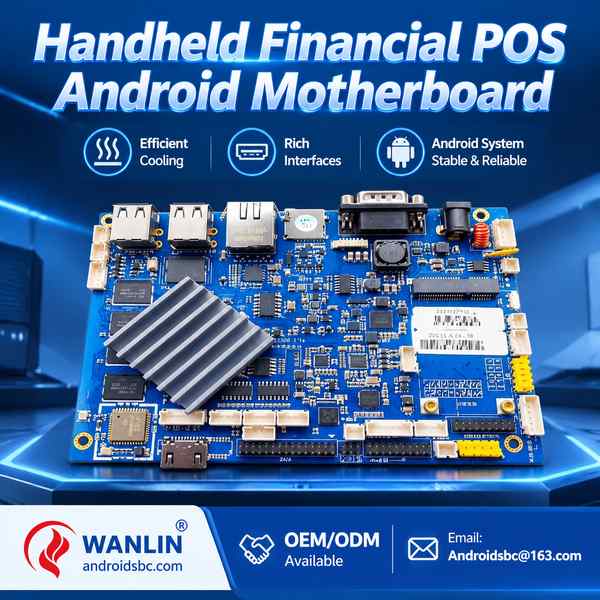
AndroidSBC sourcing desk: RK3568 and A133 handheld POS board pricing held flat through the current quarter serving international market, United States. The WF-POSH-09 handheld financial POS Android motherboard covers the logistics barcode handheld POS build and eleven sister configurations in the WF-POSH series, spanning the A133 quad-core ARM Cortex-A53 1.6GHz SoC with the Imagination PowerVR GE8300 GPU, 5.5-inch 720x1280 MIPI DSI sunlight readable panel, and Android 12 with AOSP baseline firmware support. AndroidSBC, the export arm of Wanlin Manufacturing Group, ships the WF-POSH family from the Longgang source factory in Shenzhen to international market and United States importers who build handheld payment terminals, mobile checkout devices, delivery collection units, warehouse scanners and field service handhelds.
WF-POSH-09 Technical Specifications
| Parameter | AndroidSBC WF-POSH-09 (logistics barcode handheld POS build) | Industry Average |
|---|---|---|
| Processor | A133 quad-core ARM Cortex-A53 1.6GHz SoC | Older dual-core or quad-core Cortex-A7 SoC |
| Process node | 28nm | Older 40nm process |
| GPU | PowerVR GE8300 | Older Mali-400 or basic 2D GPU |
| Memory | 4GB LPDDR4 | DDR3 512MB or 1GB on competing boards |
| Storage | 32GB eMMC plus TF card up to 128GB | NAND flash 4GB or 8GB on competing boards |
| Display and touch | 5.5-inch 720x1280 MIPI DSI sunlight readable panel with 5-point capacitive touch with glove support | 4.3-inch 480x800 panel with resistive touch |
| Payment and capture | 1D and 2D scan engine plus RFID reader and NFC contactless | Camera-only QR capture with no scan engine |
| Printer and peripherals | label printer header for 58mm and 80mm media | No printer control header on competing boards |
| Wireless and positioning | 4G LTE Cat 4 modem plus dual-band WiFi, Bluetooth 5.0 and GPS | Single-band 2.4G WiFi 802.11n with no modem |
| Interfaces | 1 USB Type-C host and OTG, 1 RS232, 1 TTL UART, 6 GPIO, 1 SIM slot, 1 scan engine header, 1 thermal printer header | One USB port and no RS232 |
| Operating system | Android 12 with AOSP baseline | Android 9 or Android 10 on competing boards |
| Power and reliability | 3.7V 5000mAh battery management with 5V/2A fast charge, -20C to 60C operating ambient | No battery management and no watchdog |
All parameters in the table above are measured at 25C ambient. The AndroidSBC WF-POSH-09 (logistics barcode handheld POS build) holds the touch panel, the thermal printer and the scan engine together while running the 72-hour burn-in loop, a configuration that competing single-platform boards rarely document at the top of the temperature window. For United States importers sourcing the WF-POSH family, the WF-POSH-09-A variant is the typical configuration for the warehouse picking and last-mile proof of delivery use case, in a handheld terminal footprint with a sustained weekly capacity of 5000 pcs/wk.
Challenges in Sourcing Handheld Financial POS Android Motherboards for United States Buyers
Handheld payment hardware punishes boards in a way that office equipment never does. A terminal runs a twelve-hour shift on one battery, gets dropped, prints thermal receipts in direct sun, and is expected to decode a damaged barcode first time - the United States rollout fails on those details long before it fails on CPU benchmarks.
For power AndroidSBC supplies the arithmetic rather than an opinion: the battery charge curve, the printer peak current and the standby draw are documented per lot, and the FCC / UL route applied in United States is issued against the factory, not against a reseller. The 3rd release for international market - 26000 units on September 29, 2026, international market - Shanghai lane - was built against the same reference image the partner qualified, so the terminals went live without a re-test cycle.
WF-POSH-09 Application Scenarios
The WF-POSH-09 logistics barcode handheld POS build sits inside a twelve-configuration WF-POSH Android motherboard family from AndroidSBC, a Wanlin Manufacturing Group export brand. The WF-POSH-09-A configuration is the typical build for the warehouse picking and last-mile proof of delivery use case, with printer current profile, scan engine mapping and staged OTA management bundled.
- Convenience and grocery checkout: the WF-POSH-12 turns a queue into a transaction at the shelf rather than at the till.
- Quick-service restaurants and milk tea counters: the WF-POSH-11 takes the order, prints the ticket and takes payment in one pass.
- Delivery and last-mile collection: the WF-POSH-08 pairs the LTE modem with the scan engine and the printer for proof of delivery at the door.
- Warehouse picking and stocktaking: the WF-POSH-05 runs a twelve-hour shift on one battery with a sunlight readable panel.
- Parking, tolling and traffic enforcement: the WF-POSH-10 prints a citation and takes contactless payment on the same device.
- Banking agents and field insurance: card, QR and electronic signature capture away from a branch network.
- Mobile ticketing and event entry: scan, print and take payment at a gate without fixed infrastructure.
- Pop-up markets and street vending: a merchant account on a device that fits in an apron pocket.
- Retrofit programmes in international market: the same board re-uses the installed printer mechanism and scan engine, so an estate can be refreshed device by device.
Partnership Models for international market Buyers
The WF-POSH family is offered on distribution, integration or private-label terms, and a international market partner can run more than one at a time.
- Distribution track: the partner buys the WF-POSH board against a published price list, keeps its own stock, and AndroidSBC supplies the printer profile, the scan mapping and the compliance documents with each lot.
- Integration track: the partner takes the board plus firmware customisation, receipt and language localisation and peripheral validation support, with a joint qualification run at the Longgang factory.
- Private-label track: the WF-POSH board ships under the partner brand with customised boot logo, packaging, enclosure and documentation, on a fixed bill of materials held for the length of the agreement.
Whichever track a United States partner starts on, the technical deliverable is identical - the same board, the same peripheral configuration and the same compliance pack.
Does the handheld POS board family support a logistics barcode handheld POS build?
Answer: Yes - logistics barcode handheld POS build is supported across the WF-POSH line, and the international market configuration is locked as the reference for later lots so re-orders behave identically.
Which configurations are available in the WF-POSH family for United States buyers?
Answer: Configurations differ on silicon, display and radio, not on the payment peripheral contract. A United States buyer that has qualified NFC, printer and scanner on one WF-POSH build keeps that qualification across the rest of the line.
Can one handheld POS board drive a touch panel, a thermal printer and a scan engine at once?
Answer: It can, and that is the point of the family. The printer header, the scan engine interface and the display lane are validated together on the Longgang bench for the international market configuration before the lot is released.
What payment scheme certification support does AndroidSBC provide for United States?
Answer: The honest answer for United States is that scheme certification sits with the finished terminal, not with the bare board. AndroidSBC supports it with the secure element interface, the hardware crypto path and the evidence pack, and the international market partner or acquirer completes the certification.
What is the minimum order quantity and the sample lead time for United States?
Answer: Samples leave Longgang in 1-3 days and volume orders in 15-30 days. A international market partner starting on a stock configuration can begin at sample quantity and convert to a call-off schedule later.
Is custom ROM, boot logo or pre-installed app development available?
Answer: Yes. Custom ROM, boot logo, boot animation, pre-installed applications and launcher lockdown are all available. The board ships on an AOSP baseline, and GMS licensing or EDLA enrolment is arranged per programme - AndroidSBC supplies the hardware, the Android version and the test evidence, while the international market partner or brand owner completes the agreement with Google.
How are firmware updates delivered to a United States device estate after deployment?
Answer: Updates are delivered over a staged OTA channel with a rollback image. A United States partner can pilot an update on a small group of terminals, hold it, and then release it across the estate, and USB and TF card upgrade paths remain available for sites with no network.
What shipping terms does AndroidSBC support for United States orders?
Answer: Shipments to United States run EXW, FOB Shenzhen or CIF on the Port of international market lane, and DDP is offered once a lane is established. Compliance paperwork is packed with the goods.
Contact AndroidSBC: Start Your WF-POSH-09 Sourcing Conversation
international market integrators can reach the AndroidSBC export desk for the handheld POS board family through the following channels:
- Email: Androidsbc@163.com
- Export service hotline: +8613261677119
- Website: https://www.androidsbc.com
- Source factory address: Wanlin Group, Building B, Building 1, Beisida Medical Device Building, 28 Nantong Avenue, Baolong Community, Baolong Sub-district, Longgang District, Shenzhen, Guangdong, China
A 1-3 day sample lead applies to United States buyers, a 15-30 day mass-production lead to bulk orders, and a seven-year firmware update window to the WF-POSH family.