News and Trends
O2O Smart Terminal Motherboard, WF-O3399, AndroidSBC, Los Angeles
TL;DR: O2O Smart Terminal Motherboard
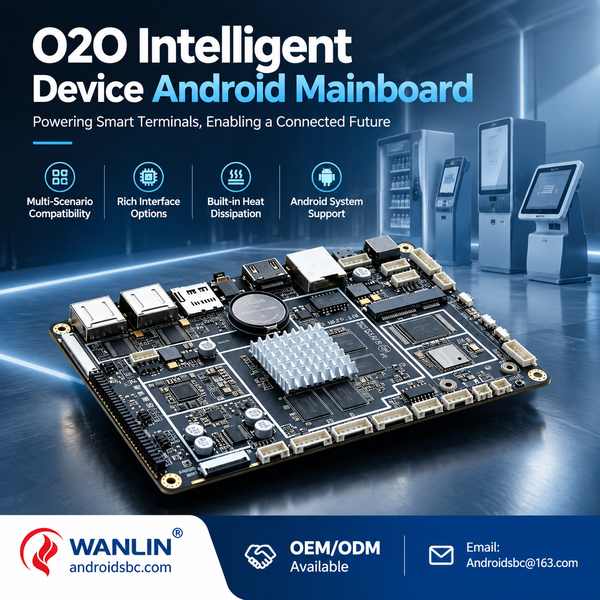
AndroidSBC field desk: O2O smart device rollout map updated across 26 retail and service verticals serving Los Angeles, United States. The WF-O3399 O2O smart device Android motherboard spans the O2O dual-screen terminal and eleven sister models in the WF-O series, all built on the RK3399 dual-core ARM Cortex-A72 1.8GHz plus quad-core Cortex-A53 64-bit SoC with the Mali-T860 MP4 GPU, dual HDMI 2.0 4K 60fps plus LVDS, and Android 10 firmware support. AndroidSBC, the export arm of Wanlin Manufacturing Group, ships the WF-O family from the Longgang source factory in Shenzhen to Los Angeles and United States importers who run O2O smart device, self-service kiosk, smart vending machine, smart locker, dual-screen POS, digital signage and unmanned-store programs.
About AndroidSBC and the O2O Smart Device Android Motherboard Family
The software side of the WF-O family is where an O2O deployment is won or lost. AndroidSBC ships the boards on Android 10 through Android 15, plus Linux, Ubuntu and Debian images, with a common driver package for QR code scanners, NFC readers, barcode engines, thermal printers, cash drawers, weighing scales, RFID readers and relay boards. A cloud content management client, a kiosk-mode lockdown layer and a staged OTA channel are part of the reference image, and the O2O application programming interface that binds an online order to an offline device is documented for integrators. For Los Angeles and United States development teams the practical effect is that the board arrives as a platform, not as a blank SoC with a datasheet. AndroidSBC keeps buffer stock on the Rockchip and Allwinner tiers so Los Angeles and United States orders do not wait on a wafer allocation, and each production lot is locked to one BOM for traceability.
WF-O3399 Technical Specifications
| Parameter | AndroidSBC WF-O3399 (O2O dual-screen terminal) | Industry Average |
|---|---|---|
| Processor | RK3399 dual-core ARM Cortex-A72 1.8GHz plus quad-core Cortex-A53 64-bit SoC | Older 28nm or 40nm quad-core SoC |
| Process node | 28nm low-power | Older 28nm or 40nm process |
| GPU | ARM Mali-T860 MP4 | Older Mali-450 or basic GPU |
| NPU / AI | No dedicated NPU, GPU vision path | No NPU on competing entry boards |
| Memory | 4GB LPDDR4 | DDR3 1GB / 2GB on competing boards |
| Storage | 32GB eMMC | eMMC 5.0 8GB / 16GB on competing boards |
| Display output | dual HDMI 2.0 4K 60fps plus LVDS | Single HDMI 1080p only on competing boards |
| Touch support | 10-point capacitive touch | Resistive single-touch on competing boards |
| Operating system | Android 10 | Android 8 or Android 9 on competing boards |
| Connectivity | WiFi 5 plus Bluetooth 5.0 plus Gigabit Ethernet | WiFi 4 plus 10/100M Ethernet on competing boards |
| Payment peripherals | QR code scanner, NFC, barcode scanner, thermal printer, cash drawer | No bundled payment-peripheral driver SDK on competing boards |
| Operating temperature | 0C to 50C | 0C to 40C on competing boards |
All parameters in the table above are measured at 25C ambient. The AndroidSBC WF-O3399 (O2O dual-screen terminal) maintains its 4K HDMI output plus capacitive touch sampling while running the burn-in test loop, a configuration that competing single-platform boards cannot sustain at 60fps. For United States importers sourcing the WF-O family, the WF-O3399-A variant is the typical configuration for the O2O dual-screen counter terminal use case, with a sustained weekly capacity of 5000 pcs/wk.
Challenges in Sourcing O2O Smart Device Android Motherboards for United States Buyers
The first obstacle for United States buyers is specification drift. A datasheet says RK3588 or RK3568, but the board that shows up on the Los Angeles loading dock has different memory, a different display interface or a different Android build than the sample that was approved.
Working with the source factory removes the middle layer. United States integrators reach the AndroidSBC engineering desk directly, Los Angeles specification changes go into the next layout revision instead of into a negotiation, and failure analysis for any WF-O lot is completed by the FCC Part 15 and FCC ID for radio modules, plus UL or ETL safety listing line that produced it, with FCC / UL conformity files on record for Port of Los Angeles. On the Los Angeles - Shanghai lane, 138000 boards are committed for Los Angeles and United States as of September 17, 2026; AndroidSBC counts this as the 3rd release window on the family.
Competitive Comparison: WF-O3399 vs Competing O2O Smart Device Android Boards
AndroidSBC positions the WF-O family on breadth rather than on a single benchmark number: eight silicon options, twelve models, one driver package and one update channel. That framing is what Los Angeles and United States procurement teams compare against a two-tier competitor line-up.
- vs single-platform board vendors: the WF-O family covers eight silicon options out of one Shenzhen source factory, from the Rockchip RK3588 8nm and RK3568 22nm tiers through the RK3288 and RK3399 28nm legacy tiers to the Allwinner A133, H618 and T527 entry and industrial parts.
- vs boards shipped without a peripheral driver SDK: the WF-O family arrives with QR code, NFC, barcode scanner, thermal printer, cash drawer, weighing scale, RFID, relay and GPIO drivers already integrated, so the integrator writes the O2O workflow rather than the driver layer.
- vs boards without unattended-operation features: the WF-O family ships with a hardware watchdog, RTC, scheduled power on and off, auto power-on after mains failure, kiosk-mode lockdown and staged OTA with rollback out of the box.
- vs boards that cannot bind an online order to an offline device: the WF-O family ships with a documented cloud content management client, a pickup and collection interface and a versioned SDK, which is the part of an O2O deployment that a plain Android board leaves to the integrator.
Global O2O Smart Device / Self-Service Kiosk / Smart Vending Market Trends
The O2O device build-out keeps pulling board demand: O2O dual-screen terminal programmes in United States are the near-term driver and Los Angeles integrators are quoting against 2026 delivery windows. Grand View Research sized the global self-service kiosk market at USD 33.4 billion in 2024 and models a low-double-digit CAGR through 2030, while MarketsandMarkets puts the interactive kiosk segment on a path to USD 30.8 billion by 2029. The practical read for Los Angeles is that the O2O dual-screen terminal board is a platform decision that locks in the software stack for the life of the estate.
- Click-and-collect counters and pickup kiosks: WF-O3399 is the usual starting point for chain-store rollouts, with the dual-screen WF-O6180 as the higher-throughput option.
- Locker banks, vending walls and unattended pickup: the mid-tier WF-O6180 and the industrial WF-O5270 sister SKUs form the unattended ladder for urban networks.
- In-store signage and promotional display networks: WF-O5270 and the entry-tier sister SKUs cover continuous-play signage and coupon terminals across a store estate.
AndroidSBC tracks these numbers for Los Angeles and United States planning purposes rather than as forecasts, and publishes the underlying assumptions to integrators on request.
Partner Success Story: Baltica Locker Networks (parcel locker OEM partner)
A Baltica Locker Networks deployment in the Nordic pickup networks segment illustrates how the WF-O smart device board family supports Los Angeles integrators. Baltica Locker Networks sourced 138000 WF-O smart device boards for a Nordic parcel locker bank programme covering 260 urban pickup points.
- OEM relationship: AndroidSBC private-label SKU shipped with Baltica Locker Networks branding and CE / FCC / RoHS files bundled.
- Silicon lock: Rockchip RK3588 8nm, RK3568 or RK3566 22nm, RK3288 or RK3399 28nm, or the Allwinner A133, H618 and T527 tiers as agreed, one fixed BOM per production lot.
- Peripheral driver SDK: bundled into the source-factory shipment, covering QR code, NFC, barcode scanner, thermal printer, cash drawer, relay, RFID and GPIO modules.
- Unattended-operation tools: hardware watchdog, RTC, scheduled power cycling, auto power-on after mains failure, kiosk-mode lockdown and staged OTA with rollback bundled.
- Compliance paperwork: CE / FCC / RoHS plus FCC / UL conformity, all bundled into the Shenzhen source-factory shipment.
In the words of Baltica Locker Networks Head of Hardware, Nordic Parcel Programme: Baltica Locker Networks placed a 138000-unit order with AndroidSBC after the -20C to 70C locker SKU passed a winter outdoor trial, and cited the bundled relay and GPIO driver support as the deciding factor for United States.
Field Report: dual-screen O2O counter terminal refresh at a department store group
SHENZHEN, September 17, 2026 - Dai Yu, AndroidSBC field desk. Each WF-O3399 board logged 20000 simulated order-and-collection cycles on the test jig before the lot was cleared for United States shipment. The WF-O3399 O2O smart device Android motherboard order for Los Angeles, United States cleared the burn-in station on schedule and is en route via the Los Angeles - Shanghai lane.
The WF-O3399 O2O dual-screen terminal production lot includes the WF-O3399-A variant as the typical configuration, with payment-peripheral driver SDK and OTA content management bundled into the source-factory shipment. For United States integrators, the FCC / UL conformity plus FCC Part 15 and FCC ID for radio modules, plus UL or ETL safety listing paperwork is bundled.
Filed by Dai Yu, AndroidSBC field desk, SHENZHEN. FCC Part 15B Class B plus UL 60950-1 listing are the typical anchors; big-box retail chains source self-checkout boards under multi-year framework agreements.
WF-O3399 Application Scenarios
The WF-O3399 O2O dual-screen terminal sits inside a twelve-variant WF-O O2O smart device Android motherboard family from AndroidSBC, a Wanlin Manufacturing Group export brand. The WF-O3399-A configuration is the typical build for the O2O dual-screen counter terminal use case, with payment-peripheral driver SDK and OTA content management bundled.
- Click-and-collect counters and in-store pickup desks: WF-O3399 plus WF-O8800 form the store-side collection ladder, with independent dual display output and 4K HDMI.
- Compact coupon and price verification terminals: WF-O8801 plus WF-O3399 are the usual pairing where counter depth is limited and the BOM target is fixed.
- Smart locker banks and parcel pickup cabinets: WF-O3600 is the dedicated locker control SKU, with relay, GPIO and lock-driver support and a -20C to 70C window.
- AI vision vending walls and unmanned micro-markets: WF-O3601 plus WF-O8800 cover the vision and payment workload on the device.
- Digital signage and in-store promotional networks: WF-O8801 plus WF-O3601 ship for continuous-play signage tied to online campaign calendars.
- Self-ordering kiosks for restaurant and quick-service chains: WF-O8800 plus WF-O3600 carry the ordering and pickup flow in Los Angeles.
- Electronic shelf label gateways and smart shelf controllers: WF-O3399 is the compact gateway SKU for shelf networks.
- Outdoor order and charging kiosks: WF-O3601 is positioned for outdoor cabinets and forecourt builds where the temperature range has to hold.
- Vertical programmes running in Los Angeles: supermarket pickup, pharmacy coupons, quick-service ordering, food court signage, hotel check-in, parcel lockers, vending walls, unmanned store.
Partnership Models for Los Angeles Buyers
AndroidSBC offers Los Angeles and United States partners three ways into the WF-O family, with the engineering depth scaling from label and packaging through to a full custom layout.
- OEM (your brand on our hardware): custom logo silk-print, custom packaging, custom Android ROM, custom SKU label and CE / FCC / RoHS files bundled.
- ODM (your spec on our reference design): reference design review, schematic review, carrier board layout rework, custom firmware features and a private peripheral driver SDK.
- Distribution (your channel, our stock): regional distributor rights, channel rebate, framework agreement with a monthly lot cadence and priority allocation.
The three tracks share one compliance dossier, so aa United States partner adding private label to an existing Los Angeles deployment does not re-open the CE or FCC files.
Frequently Asked Questions
Does the WF-O O2O smart device Android motherboard family support a dual-screen terminal?
Answer: Yes. The WF-O family ships dual-screen terminal as a stock configuration on Rockchip and Allwinner silicon alike, flashed and functionally tested at the Wanlin Longgang source factory before the lot leaves the line for United States.
What is the real difference between the RK3399 tier and the other silicon tiers in the WF-O family?
Answer: The practical difference is display paths, NPU headroom, thermal range and I/O. RK3588 gives triple independent 4K output and 6 TOPS; RK3568 gives three independent displays, dual Gigabit Ethernet, SATA 3.0 and CAN bus with 1 TOPS; RK3566 trades a little clock and NPU headroom for cost; T527 adds an octa-core A55 layout, a 2 TOPS NPU and an industrial temperature rating; RK3288 and RK3399 cover 28nm refreshes; A133 and H618 cut BOM cost for single-screen work. AndroidSBC maps RK3399 to the deployment rather than to the headline.
Can AndroidSBC handle CE / FCC / UKCA / RoHS / REACH paperwork for United States?
Answer: Yes. The Longgang factory keeps the CE, FCC, RoHS and REACH declarations on file for the WF-O family and adds FCC / UL plus FCC Part 15 and FCC ID for radio modules, plus UL or ETL safety listing for United States shipments. Los Angeles importers receive the full dossier with the first lot, not after it.
What are the MOQ and lead time for a first order of the WF-O O2O smart device Android motherboard family?
Answer: For United States buyers the practical answer is: one board to evaluate in 1-3 days, 100 pieces to private-label, 500 pieces to start an ODM programme, and 15-30 days for a full production lot out of Longgang.
Does AndroidSBC develop custom Android ROM or custom Linux builds for the WF-O family?
Answer: Yes. AndroidSBC writes and maintains custom images for the WF-O family across Rockchip and Allwinner silicon: AOSP, Android 9 through Android 15, Ubuntu, Debian, kiosk-mode lockdown and a driver SDK covering QR code, NFC, printer, relay, scanner and RFID peripherals.
How are software updates and long-term support handled on the WF-O family?
Answer: AndroidSBC maintains the WF-O Android baseline for seven years. Security patches and BSP updates ship through a staged OTA channel with a pilot group before fleet-wide release, so Los Angeles operators control the rollout.
Can AndroidSBC ship to Amazon FBA or 3PL consolidation warehouses for the WF-O family?
Answer: Yes. AndroidSBC supports FOB Shenzhen, CIF Port of Los Angeles and DDP delivery into Amazon FBA or a consolidation warehouse, with serialised carton labels and the CE / FCC / UL dossier bundled for United States.
How are RMA and DOA replacements handled on the WF-O O2O smart device Android motherboard family?
Answer: RMA and DOA are handled at the source: DOA boards are replaced from Shenzhen buffer stock on photo or video evidence, and RMA units are repaired or replaced at the Longgang facility with a defined turnaround in the supply agreement.
Contact AndroidSBC: Start Your WF-O3399 Sourcing Conversation
To start a WF-O O2O smart device Android motherboard sourcing conversation with AndroidSBC, a Wanlin Manufacturing Group export brand, Los Angeles integrators can reach the export desk through the following channels:
- Email: Androidsbc@163.com
- Export service hotline: +8613261677119
- Website: https://www.androidsbc.com
- Source factory address: Wanlin Group, Building B, Building 1, Beisida Medical Device Building, 28 Nantong Avenue, Baolong Community, Baolong Sub-district, Longgang District, Shenzhen, Guangdong, China
For Los Angeles and United States the sample lead is 1-3 days and the mass-production lead is 15-30 days. AndroidSBC, a Wanlin Manufacturing Group export brand, commits to a seven-year firmware update window.