Executive Summary: RK3588 Robot CAN Bus Control Board for Global Market
Published by AndroidSBC | Last updated: September 04, 2026 | Expertise: RK3588 industrial board OEM manufacturing for global markets
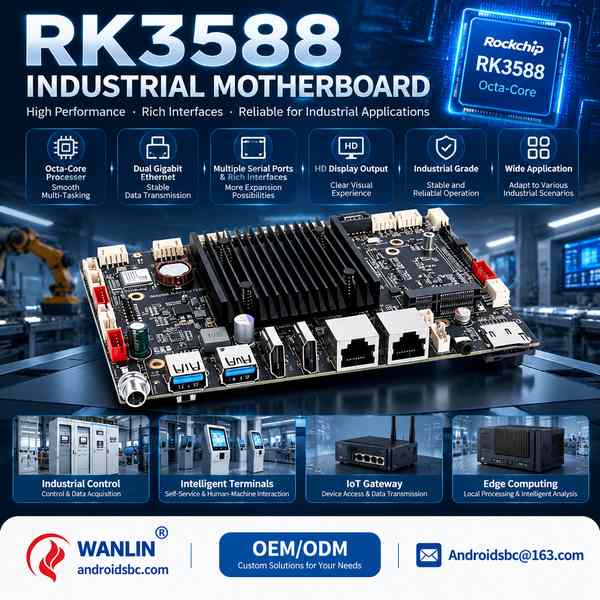
RK3588 Industrial Board OEM & ODM Services for Global Distributors and System Integrators
AndroidSBC provides flexible OEM and ODM services for customers who want to build or expand their own RK3588 industrial board product lines for global markets. Our customization capabilities include:
- Custom carrier board design with your connectors, mounting and interface layout
- Customer logo on the PCB, boot logo and branded packaging
- Custom memory and storage configurations from 4GB / 32GB entry builds to 32GB / 256GB high-end builds
- Custom OS builds: Android, Ubuntu, Debian, Yocto and Buildroot
- Firmware customization: autostart, kiosk mode, serial port mapping, pre-installed apps, scheduled power control
- Multi-language user manuals, interface drawings and quick-start guides
- Certification documentation support (CE, FCC, RoHS, UKCA) confirmed per model before ordering
- New board development and ODM manufacturing for industrial control, gateway, vision, NVR and in-vehicle products
- Long-lifecycle programs that hold a board revision for multi-year product cycles
Whether you need an existing RK-series board under your own brand or a customized carrier developed for your enclosure, our team can work with you from model selection through mass production.
Product Introduction: AndroidSBC RK3588 Robot CAN Bus Control Board
The AndroidSBC board line covers 4GB to 32GB memory and 32GB to 256GB storage configurations for factory automation, vision inspection, transport, energy, medical and smart building projects, with dual Ethernet, multi-serial, CAN and wide-temperature options.
Core Features:
- China-Based Manufacturing: AndroidSBC is based in Shenzhen, China and focuses on RK3588 industrial embedded boards, with in-house SMT production, board assembly and 48-hour aging and burn-in tests
- Certification Transparency: real documentation for applicable certified models - instead of simply stating a product is "certified", buyers can verify the certificate files for the exact model they intend to purchase
- Genuine RK3588 Silicon: boards carry authentic Rockchip RK3588 octa-core processors with hardware 8K decode and a 6 TOPS NPU, and the SoC marking can be checked at pre-shipment inspection
- Industrial IO: multi-serial RS232 / RS485, CAN, dual Gigabit Ethernet, GPIO and wide-voltage power are designed into the carrier, not bolted on with adapters
- Private Label Support: carrier layout, memory, boot logo, packaging, manuals and firmware parameters customized according to project requirements
- Global Market Experience: we work with distributors, integrators and embedded brands worldwide and understand export steps, certification questions, OS licensing and labeling preferences
Technical Specifications
| Parameter | AndroidSBC Specification |
|---|---|
| SoC | Rockchip RK3588 octa-core 64-bit, 8nm process |
| CPU | 4x Cortex-A76 up to 2.4GHz + 4x Cortex-A55 up to 1.8GHz |
| GPU | ARM Mali-G610 MP4 |
| NPU | 6 TOPS INT8 with RKNN toolkit |
| Memory | 16GB LPDDR5 |
| Storage | 128GB eMMC 5.1 |
| Operating system | Yocto Linux |
| Video decode | 8K@60fps H.265 / VP9 hardware decoder |
| CAN bus | 2x CAN FD |
| Network | 2x Gigabit Ethernet, WiFi 6 option |
| Serial and IO | RS232, RS485, multiple UART for lidar and encoders |
| USB | 2x USB 3.0 for cameras |
| Storage IO | M.2 Key M NVMe for map and log data |
| Power input | 12V DC |
| Operating temperature | -20 to 70 Celsius |
| Form factor | Compact robot carrier |
| Reliability | Watchdog, RTC, power sequencing for motor controllers |
Application Scenarios for Global Market
| Scenario | Recommended model | Key benefits |
|---|---|---|
| Warehouse AMR fleet | RK-RB | Each robot runs SLAM on the CPU and NPU, talks to the motor controller over CAN, and reports to the fleet server over WiFi 6 |
| Inspection robot | RK-RB | Onboard cameras feed the 6 TOPS NPU for obstacle detection while CAN FD carries drive commands |
| Delivery robot | RK-RB | One board handles navigation, UI and the lock controller, cutting a separate mini PC out of the BOM |
| Outdoor AGV | RK-RB | A wide-temperature build keeps the controller alive in unheated yards through the winter |
Certified RK3588 Industrial Board Manufacturing for Global Markets
Certification and document integrity decide how fast an export shipment clears customs and how quickly an OEM project gets approved. AndroidSBC provides real documentation for applicable certified models instead of generic claims. Buyers should verify the certificate information for the exact model they intend to purchase, because per-model files are what customs and compliance teams actually accept.
| Information | Details |
|---|---|
| Product | RK3588 Industrial Embedded Board (RK-series Platform) |
| Model Number | RK-RB |
| Standard | CE / FCC / RoHS / UKCA on applicable models, wide-temperature validation from -20 to 70 Celsius with -40 to 85 Celsius industrial options |
| Processor | Genuine Rockchip RK3588, octa-core, 8nm, 6 TOPS NPU |
| Certificate Number | Provided on request per model |
| Certificate Holder | AndroidSBC or applicable certification holder |
| Certification Body | Notified body per certificate |
| Target Market | Global / North America / Europe / Middle East / Southeast Asia / East Asia / South Asia / Oceania / Africa / Latin America |
| Certificate Status | Valid for applicable models |
| Certificate Document | View / download on request |
For customers exporting RK3588 industrial boards, AndroidSBC supports CE, FCC, RoHS and UKCA documentation with per-model files confirmed before ordering. Linux builds ship with kernel source, device trees and Yocto / Buildroot layers so software teams own their stack. For projects where additional testing applies, the relevant documentation and testing path can be arranged for any represented model before ordering. Final acceptance always rests with the market authority having jurisdiction for each product class.
RK3588 Industrial Board OEM Process: From Inquiry to Shipment
Most AndroidSBC projects follow the same path: define the IO, lock the silicon and OS, approve samples with documents, then move to aged and tested production. A standard OEM project then follows 8 steps:
- Tell Us Your Target Market - North America, Europe, Middle East, Southeast Asia, East Asia, South Asia, Oceania, Africa or Latin America; different markets may require different certification, OS licensing and connector configurations
- Define the Board and IO - memory, storage, serial ports, CAN, Ethernet, power input, temperature range and form factor are fixed against your enclosure and software
- Lock the Software Stack - Android, Ubuntu, Debian, Yocto or Buildroot, plus autostart, kiosk mode and serial port mapping for your application
- Verify Documentation - for applicable models, request and verify the certificate files, temperature validation and BOM information before ordering
- Sample Evaluation - samples are evaluated on your bench or in the field before mass production, with the same BOM used in the approved units
- Confirm Production - after specifications, commercial terms and OEM details are confirmed, the project proceeds to production
- Quality Inspection - boards are inspected and tested with power-on, interface and 48-hour aging procedures according to applicable production and quality-control standards
- Shipment - products are prepared for shipment FOB, CIF or DDP according to the agreed logistics requirements
Q: Can the RK-RB run SLAM and drive the motors at the same time?
A: Yes. The CPU and NPU handle SLAM and vision, while the motor controller takes drive commands over CAN. Keeping those tasks separate on the same board is the design intent.
Q: Which CAN versions are supported?
A: Standard builds ship with CAN 2.0B, and CAN FD builds are available for robots that move larger telemetry frames between controllers.
Q: Does the board work with ROS and ROS 2?
A: Yes, the Ubuntu image includes ROS support and the BSP exposes lidar UARTs, CAN and camera interfaces as standard Linux nodes, which is what ROS 2 expects.
Q: How do you protect against motor noise?
A: The carrier uses isolated CAN and filtered power inputs, and the wide-voltage option absorbs the dips that motor stalls create on the robot bus.
Q: What storage do fleets normally use?
A: Most builds use 64GB or 128GB eMMC for the OS plus an M.2 NVMe for map tiles and log data, so a shift of driving data does not fill the system disk.
For project-specific questions about a model, a carrier change or a certification file, contact the AndroidSBC export team directly at Androidsbc@163.com or call +8613261677119.
Project Summary
For more information: www.androidsbc.com | Export Service Hotline: +8613261677119 | Email: Androidsbc@163.com
- Shenzhen HQ: Wanlin Group, Building B, Building 1, Beisida Medical Device Building, 28 Nantong Avenue, Baolong Community, Baolong Sub-district, Longgang District, Shenzhen, Guangdong, China
