Wanlin Group · WanlinSBC · A133 POS motherboard LVDS output Flagship for Hungary Buyers - Wholesale Dual-Screen POS Terminal Bo
A133 POS motherboard LVDS output Flagship for Hungary Buyers - Wholesale Dual-Screen POS Terminal Bo
POS motherboard LVDS output Dual-Screen POS Terminal Boards Hungary export OEM ODM wholesale
A133 POS motherboard LVDS output Flagship for Hungary Buyers - Wholesale Dual-Screen POS Terminal Bo
Content updated:
Configuration: Review the technical details below and specify the required hardware and software revision.
Availability: Request confirmation for the selected configuration.
Details
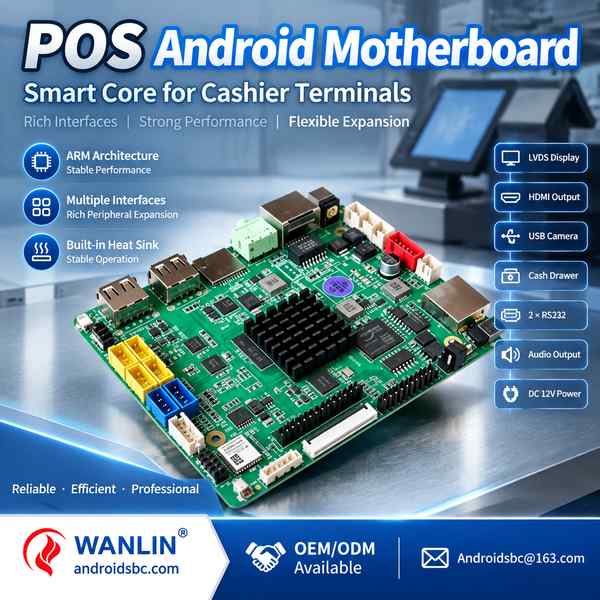
From September 23, 2026, Hungary POS brands and integrators can source the WF-A133-DS180 straight from Wanlin Group (Shenzhen, China), Allwinner A133 quad-core SoC, 8GB LPDDR4X, 256GB eMMC + Hardware 4K@30fps H.265 / H.264 decode, Android 11 / Android 12, under the 2026 Dual-Screen POS Terminal Boards program: Dual-Screen POS Terminal Boards, WF-A133-DS180, 8GB LPDDR4X + 256GB eMMC, with dual-screen cashier terminals with a customer-facing payment or promotion panel, counter units that drive line-item review and media playback from one board, configured to the needs of Dual-Screen POS Terminal Boards. Wanlin Group as the Dual-Screen POS Terminal Boards supplier, exporter and original manufacturer now serves local partners, regional exclusive distributors and strategic OEM clients in more than 60 destination markets, and the Dual-Screen POS Terminal Boards program is open to Hungary buyers ordering at factory-direct terms.
Core parameters: Allwinner A133 quad-core SoC, 22 nm process, cost-optimised POS platform. CPU 4x ARM Cortex-A53 @ 1.6 GHz, 64-bit. GPU Imagination PowerVR GE8300 GPU, OpenGL ES 3.2 / Vulkan 1.1. NPU CPU and GPU vision pipeline with an optional plug-in accelerator for barcode and QR verification. Video decode Hardware 4K@30fps H.265 / H.264 decode, 1080p H.264 encode. ISP 5 MP ISP with MIPI-CSI camera input for scanner and QR verification modules. Memory and storage 8GB LPDDR4X + 256GB eMMC. Operating system Android 11 / Android 12, Linux (Debian / Ubuntu) and Tina Linux. Display output Single or dual display via LVDS + RGB + MIPI-DSI + HDMI 1.4, up to 1920 x 1080 per screen. Interfaces and I/O USB 2.0 x4 + USB OTG, RS232 x2 / RS485 x1, GPIO / I2C / SPI, RJ11 cash drawer. Networking 10/100M Fast Ethernet with Gigabit option + WiFi 5 (802.11ac) + Bluetooth 5.0 + optional 4G LTE. Power input DC 12 V input, 9-36 V wide voltage optional. Operating temperature 0 to 60 deg C commercial, -20 to 70 deg C extended. Board dimensions Core board 85 x 56 mm / 3.5-inch SBC 145 x 100 mm / Pico-ITX 100 x 72 mm. Certifications CE / FCC / RoHS / REACH. Wanlin's 2026 export roadmap for Hungary also covers custom memory and storage combos, single and dual screen configurations, custom peripheral drivers, private-label branding and per-destination certification documentation packages.
Global Dual-Screen POS Terminal Boards Market Overview and 2026 Buyer Demand
Regional compliance for Hungary is anchored on CE under RED 2014/53/EU with Hungarian documentation and RoHS declarations. Cross-border buyers are advised to verify the certification scope, the touch driver behaviour and the software build of every board before import, since some China-supplied boards ship without destination radio approval or without the licensed Android build the project actually needs, and either gap can stall customs clearance or a venue handover.
Reference: Allwinner A133 datasheet, Allwinner A133 reference manual, Wanlin Group 2026 POS hardware export program documentation, point of sale deployment records 2024-2026.
Dual-Screen POS Terminal Boards Engineering Architecture and Hardware Platform
The Dual-Screen POS Terminal Boards family is engineered on three pillars: (1) a Allwinner A133 quad-core SoC, 22 nm process, cost-optimised POS platform compute block with CPU and GPU vision pipeline with an optional plug-in accelerator for barcode and QR verification; (2) a display, camera and peripheral pipeline built around Hardware 4K@30fps H.265 / H.264 decode, 1080p H.264 encode; (3) a software layer pairing Android 11 / Android 12, Linux (Debian / Ubuntu) and Tina Linux with till lock-down management, OTA tooling and the Allwinner Tina Linux BSP and AOSP build support. This architecture delivers continuous 24/7 checkout duty at a cost point that undercuts x86 POS terminals while keeping the touch responsiveness and till-peripheral timing integrators expect.
Three sub-modules define the engineering depth:
- Compute module - Allwinner A133 quad-core SoC, 22 nm process, cost-optimised POS platform. 4x ARM Cortex-A53 @ 1.6 GHz, 64-bit handles sustained till rendering, promotion playback and on-device inference workloads in fanless counter enclosures.
- Display and camera module - Single or dual display via LVDS + RGB + MIPI-DSI + HDMI 1.4, up to 1920 x 1080 per screen. Hardware 4K@30fps H.265 / H.264 decode, 1080p H.264 encode drives the cashier panel and the customer-facing display, and the camera path serves barcode capture, face payment verification and item recognition modules.
- Peripheral and management module - USB 2.0 x4 + USB OTG, RS232 x2 / RS485 x1, GPIO / I2C / SPI, RJ11 cash drawer. Headless operation is supported for payment-only units and facing screens fed over the store network, and the toolchain covers Allwinner Tina Linux BSP and AOSP build support, OTA upgrade, boot logo customization, pre-installed app support and launcher customization for remote fleet management.
Featured Model - WF-A133-DS180 Flagship Technical Signature
The technical signature of WF-A133-DS180 on this configuration is documented below. Every parameter is verified by our Shenzhen lab against the panel specifications of mainstream LCD vendors, the electrical limits of IEC / UL 62368-1 and the serial timing requirements of scanners, receipt printers and cash drawer circuits.
| Specification | Value |
|---|---|
| soc_platform | Allwinner A133 quad-core SoC, 22 nm process, cost-optimised POS platform |
| cpu_core | 4x ARM Cortex-A53 @ 1.6 GHz, 64-bit |
| gpu_3d | Imagination PowerVR GE8300 GPU, OpenGL ES 3.2 / Vulkan 1.1 |
| ai_vision | CPU and GPU vision pipeline with an optional plug-in accelerator for barcode and QR verification |
| video_decode | Hardware 4K@30fps H.265 / H.264 decode, 1080p H.264 encode |
| camera_isp | 5 MP ISP with MIPI-CSI camera input for scanner and QR verification modules |
| memory_storage | 8GB LPDDR4X + 256GB eMMC |
| os_android | Android 11 / Android 12, Linux (Debian / Ubuntu) and Tina Linux |
| display_out | Single or dual display via LVDS + RGB + MIPI-DSI + HDMI 1.4, up to 1920 x 1080 per screen |
| counter_io | USB 2.0 x4 + USB OTG, RS232 x2 / RS485 x1, GPIO / I2C / SPI, RJ11 cash drawer |
| networking | 10/100M Fast Ethernet with Gigabit option + WiFi 5 (802.11ac) + Bluetooth 5.0 + optional 4G LTE |
| power_input | DC 12 V input, 9-36 V wide voltage optional |
| operating_temp | 0 to 60 deg C commercial, -20 to 70 deg C extended |
| board_dimension | Core board 85 x 56 mm / 3.5-inch SBC 145 x 100 mm / Pico-ITX 100 x 72 mm |
| use_case | dual-screen cashier terminals with a customer-facing payment or promotion panel, counter units that drive line-item review and media playback from one board |
Dual-Screen POS Terminal Boards Application Scenarios across Deployment Sites
Deployment notes below come from live Dual-Screen POS Terminal Boards counters on several continents, each carrying a site, a unit count and a measured outcome.
Scenario 1: convenience counters with a facing promotion panel (Kaohsiung, Taiwan, China). A convenience operator fitted 58 counters where the cashier panel drives the till flow and the 11.6-inch customer panel shows line items and the weekly promotion loop from separate framebuffers. Measured result: unscanned or mis-scanned items caught by customers before payment rose 31% and promotion recall at exit interviews rose 2.4x.
Scenario 2: bank-adjacent service desks with an ad loop (Nuremberg, Germany). A service chain installed 24 counters running a German-facing promotion loop on the customer panel that pauses to show the basket the moment payment starts. Measured result: campaign view-through rose 44% and checkout friction complaints stayed flat.
Scenario 3: pharmacy counters with a privacy-first second panel (Bordeaux, France). A pharmacy chain deployed 29 units where the customer panel shows only basket lines and loyalty points, never the health product detail, with a rotation-tolerant French interface. Measured result: customer privacy audit passed first time and basket disputes at collection fell 46%.
Scenario 4: electronics retail using the second panel for paperwork (Krakow, Poland). A retailer fitted 21 counters where the facing panel handles warranty registration, serial capture and e-receipt consent while the cashier panel stays on the till flow. Measured result: paper form handling time fell 63% and e-receipt consent rate rose 38%.
AndroidSBC Dual-Screen POS Terminal Boards Competitive Advantages for Cross-Border Buyers
The Dual-Screen POS Terminal Boards and the wider AndroidSBC POS portfolio deliver eight advantages for cross-border B2B buyers sourcing from Chinese manufacturers:
- Source-factory pricing - Wanlin operates the SMT lines, so FOB Shenzhen pricing runs 35-50% below western-branded x86 POS terminals with no per-device licence fee.
- Touch interface coverage - capacitive, projected capacitive and infrared touch panels up to 20 touch points ship with tuned drivers, because touch response is the first thing a cashier notices at the lane.
- Peripheral driver coverage - barcode and QR scanners on USB or serial, NFC contactless and magnetic stripe readers, IC card and PIN pad modules, thermal receipt and label printers, RJ11 cash drawer kick circuits, electronic scales, signature pads and face payment modules ship with tested drivers.
- Single and dual screen output - Single or dual display via LVDS + RGB + MIPI-DSI + HDMI 1.4, up to 1920 x 1080 per screen, including independent framebuffers so promotion playback on the facing panel never stalls the till process.
- Counter-grade I/O - USB 2.0 x4 + USB OTG, RS232 x2 / RS485 x1, GPIO / I2C / SPI, RJ11 cash drawer, covering serial peripherals, cash drawer drivers, powered USB rails and wide-voltage input for 24-hour stores.
- Multi-OS flexibility - Android 11 / Android 12, Linux (Debian / Ubuntu) and Tina Linux, so media-heavy retail projects and Linux-based controller builds run on one board.
- Custom memory and storage - 2GB-16GB DDR4 / LPDDR4 / LPDDR4X / LPDDR5 and 16GB-256GB eMMC, matching image size and workload to the counter instead of paying for capacity the lane never uses.
- Continuous-duty reliability - hardware watchdog, RTC, scheduled power on and off, auto-reboot after power failure and 7x24 duty for supermarket lanes, convenience counters, restaurant service and unattended stores.
Dual-Screen POS Terminal Boards Certifications, Standards Route and Regional Compliance
Cross-border buyers should note that public-space hardware compliance combines product marking, radio certification, safety evaluation and - for payment, self-checkout or accessibility functions - additional local evidence. For Hungary specifically, importers should confirm CE under RED 2014/53/EU with Hungarian documentation and RoHS declarations before shipment. Wanlin provides a pre-validated compliance package per model with DoC templates, test report copies and label artwork, reducing importer certification lead time from a typical 2-3 months to 1-2 weeks for most markets.
Dual-Screen POS Terminal Boards Economics, MOQ, Lead Time and Logistics Math
For a first-time buyer ordering 1,000 pieces of the WF-A133-DS180, the economics stack is:
| Cost Layer | USD per piece | USD for 1000 pcs |
|---|---|---|
| FOB Shenzhen factory price | $153.00 | $153000.00 |
| + Sea freight FCL 40HQ (estimated) | $3.40 | $3400.00 |
| CIF destination port | $156.40 | $156400.00 |
| + Customs duty 3%-10% (region dependent) | $0.84 | $842.84 |
| + Local delivery + warehousing | $5.60 | $5600.00 |
| DDP landed cost | $162.84 | $162840.00 |
Dual-Screen POS Terminal Boards FAQ - OEM, ODM, MOQ, Lead Time, Partnership
Below are eight frequently asked questions from cross-border buyers sourcing Dual-Screen POS Terminal Boards from China. Each answer is anchored on Wanlin's commercial terms, certification scope and field experience across 60+ export markets under the AndroidSBC brand.
What is the difference between OEM and ODM for Dual-Screen POS Terminal Boards?
Answer: OEM (Original Equipment Manufacturer) means Wanlin Group builds the POS board, cash register controller or finished point of sale terminal under your brand with your PCB silk-screen, logo, packaging and SKU. ODM (Original Design Manufacturer) means we redesign the carrier board, memory and storage combination, I/O set, touch interface, firmware or enclosure around your project. Both run from the same Shenzhen factory and the same firmware team: OEM lead time is 18-28 days and ODM 30-45 days including pre-compliance checks. Schematic review, custom carrier layout, AOSP or Linux build work, touch driver tuning and certification support are provided under NDA.
Which POS board should I source for my application?
Answer: Eight selection rules for cross-border buyers:
- (1) Supermarket lanes and grocery counters: WF-A133-RS120 / RS140 with a 15.6-inch main panel, scanner and receipt printer on serial and an offline transaction cache.
- (2) Restaurant counters and kitchen displays: WF-A133-RQ120 / RQ140 with a bump-bar friendly panel, KDS mirroring and day-part menu automation.
- (3) Dual-screen cashier counters: WF-A133-DS150 / DS170 with independent framebuffers, per-panel rotation and separate brightness curves for the facing screen.
- (4) Self-checkout lanes and unattended corners: WF-A133-SC130 / SC150 with scale tolerance logic, watchdog recovery and no-staff restart in under 10 seconds.
- (5) AI recognition and face payment: WF-A133-AI160 / AI170 with the GPU-accelerated vision pipeline, plus quantised model delivery and measured latency figures.
- (6) Transport, parking, fuel and venue counters: WF-A133-IV120 / IV140 with RS485 pump or controller mapping, wide-temp duty and protocol-specific peripheral support.
- (7) Peripheral-heavy payment counters: WF-A133-PM120 / PM140 driving scanner, printer, drawer, PIN pad and reader directly off the board ports.
- (8) Private-label programmes and redesign work: WF-A133-OD170 / OD180 with carrier redesign, BSP porting, signed firmware, per-unit identity provisioning and a last-time-buy window.
What software support comes with the boards?
Answer: Every board ships with Android images alongside Linux support (Android 11 / Android 12, Linux (Debian / Ubuntu) and Tina Linux), BSP source access, driver documentation, SDK material and OTA tooling. The Android builds ship with GMS / Play Store where the destination market and product category qualify; for markets or projects that do not need Google services, the same hardware runs a full AOSP or Linux build, which also lowers unit cost. Kiosk-mode launchers, auto-start app configuration, scheduled power on and off, idle reset for demo units and remote store-server agents are part of the standard integration work. The AI path uses Allwinner Tina Linux BSP and AOSP build support for product recognition, face payment verification and item counting where the project needs on-device inference.
Can the board drive two screens and the full counter peripheral set?
Answer: Yes. Single or dual display via LVDS + RGB + MIPI-DSI + HDMI 1.4, up to 1920 x 1080 per screen. The peripheral stack covers barcode and QR scanners on USB or serial, NFC contactless and magnetic stripe readers, IC card and PIN pad modules, thermal receipt and label printers, RJ11 cash drawer kick circuits, electronic scales, signature pads, face payment modules on USB or MIPI-CSI, fingerprint readers, plus speakers, amplifiers and microphones on the audio path and ambient sensors on I2C. Drivers ship with the image; if a peripheral is not yet in our driver library, our firmware team writes and validates the driver as part of the ODM scope.
What customization and partnership options does Wanlin offer?
Answer: Customization scope:
- (1) Branding - custom PCB silk-screen, private-label logo on board and enclosure, custom SKU, packaging and boot animation.
- (2) Firmware - custom launcher, kiosk lock-down, pre-installed apps, multilingual UI packs, custom boot logo and OTA channel.
- (3) Hardware - carrier board redesign, extra serial channels, custom connector maps, memory and storage combinations (2GB-16GB DDR4 / LPDDR4 / LPDDR4X / LPDDR5, 16GB-256GB eMMC), single or dual screen output, touch panel tuning for PCAP and IR overlays, RJ11 cash drawer driver, powered COM rails for scanners and printers, 4G / 5G module options and CAN bus expansion.
- (4) Software - AOSP build service, Linux BSP porting, touch and peripheral driver development, SDK modules, remote store-server agent integration and on-device model conversion for product recognition and payment verification.
- (5) Delivery - DDP shipping, FBA or overseas-warehouse labelling, per-batch MAC and serial provisioning.
Partnership Models - Authorized Reseller, Regional Distributor, Strategic OEM
Wanlin offers three partnership tiers for cross-border buyers of Dual-Screen POS Terminal Boards:
Conclusion - How to Start Your Dual-Screen POS Terminal Boards Sourcing Today
Wanlin Group's 2026 Dual-Screen POS Terminal Boards export program is open to B2B buyers, regional distributors, cross-border traders and OEM/ODM partners in Hungary and 60+ destination markets. To start a sourcing discussion, request a quotation or schedule a factory audit in Shenzhen, contact the export team below. Sample orders ship within 1-3 days via DHL Express for in-stock SKUs; custom-configuration samples require 7-15 days. Standard lead time for bulk OEM orders is 18-28 days, and Strategic OEM Partner applications are reviewed quarterly.
We invite Hungary buyers, export traders and trading companies to build long-term cooperation with Wanlin Group as your China-based OEM/ODM partner, regional exclusive distributor or strategic global supplier under the AndroidSBC brand. Wanlin is the manufacturer behind 60+ country POS terminal projects, the SMT lines and aging rooms behind every batch, and this export program. Let's build the Dual-Screen POS Terminal Boards supply chain together.
- Wanlin Group, Building B, Building 1, Beisida Medical Device Building, 28 Nantong Avenue, Baolong Community, Baolong Sub-district, Longgang District, Shenzhen, Guangdong, China
- Manufacturer: Wanlin Group / Brand: AndroidSBC / Site: www.androidsbc.com
- Export service: Email: Androidsbc@163.com | Phone: +8613261677119 | Website: https://www.androidsbc.com
- Form factor: Dual-Screen POS Terminal Boards / Chip: Allwinner A133 / Platform: Allwinner A133 quad-core SoC
- Country compliance for Hungary: CE under RED 2014/53/EU with Hungarian documentation and RoHS declarations
Publishing and verification
Published by Wanlin Group under the WanlinSBC identity. Product capabilities must be confirmed against the exact model, PCB revision, software build and current controlled document before procurement or integration.
Availability, certification scope, pricing, lead time and lifecycle commitments depend on the selected configuration and written project agreement.
