Wanlin Group · WanlinSBC · H618-TV100 Android TV and Streaming Board Evaluation Guide
H618-TV100 Android TV and Streaming Board Evaluation Guide
Evaluate the WanlinSBC H618-TV100 for Android TV, streaming and embedded display projects, including software scope, interfaces, testing and document checks.
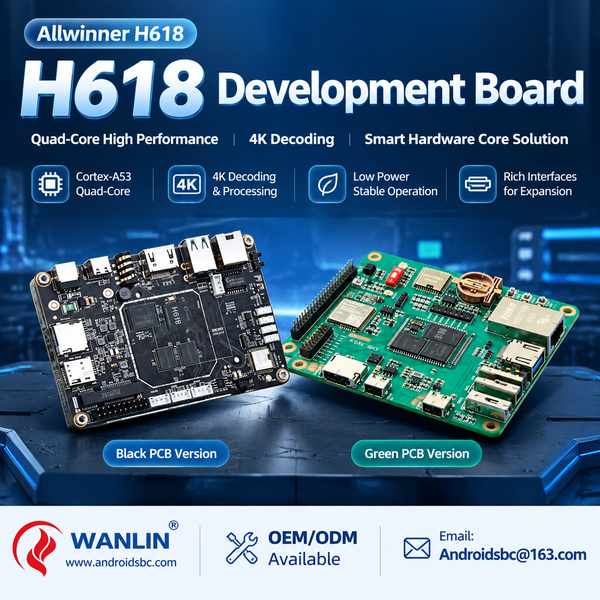
H618-TV100 Android TV and Streaming Board Evaluation Guide
Content updated:
Configuration: Review the technical details below and specify the required hardware and software revision.
Availability: Request confirmation for the selected configuration.
Details
What is the H618-TV100?
The WanlinSBC H618-TV100 is an Allwinner H618-based board reference for Android TV, streaming-player and embedded display projects. Selection must be based on the exact PCB revision, memory and storage configuration, wireless module, software build, connector layout and finished-product requirements.
Which projects should evaluate this platform?
- Android TV and OTT media devices;
- streaming players and compact display terminals;
- hospitality or information-display equipment;
- custom embedded video products requiring branded software or peripheral adaptation.
The H618 processor name alone does not prove compatibility with a specific display, codec profile, DRM service, wireless region, enclosure or application.
What must be confirmed before selection?
Specify the target resolution and display output, video formats, audio path, remote-control method, USB devices, Ethernet or Wi-Fi requirements, Bluetooth requirements, power input, enclosure dimensions, thermal limits, Android baseline, application stack and intended markets. Confirm each item against the proposed board revision and software release.
How should Android and media software be evaluated?
Identify whether the project needs AOSP, Android TV components, a custom launcher, kiosk behavior, application pre-installation, OTA strategy or third-party service integration. Licensing, DRM and service certification are separate project requirements; they must not be inferred from generic Android compatibility. Record the accepted software using a build identifier and retain a reproducible recovery image.
What should a sample test include?
- Cold boot, restart, recovery and long-duration playback.
- Display output at the required resolution and refresh rate.
- Required video and audio files under realistic workloads.
- Ethernet, Wi-Fi, Bluetooth, USB, storage and remote-control functions.
- Application stability, memory use and storage behavior.
- Thermal and power behavior inside the intended enclosure.
- Verification of the PCB revision and software build delivered for approval.
How should wireless and regulatory evidence be checked?
Wireless module choice and destination market can change the applicable test scope. Request the current report or certificate and match the applicant, model, radio module, power supply, enclosure, standard and issue date. Do not treat a CE, FCC, RoHS, GMS or other logo on a generic webpage as proof for the ordered configuration.
Which documents should a buyer request?
- current board specification and mechanical drawing;
- connector, power and interface definition;
- wireless-module identification and antenna requirements;
- software build or BSP baseline and recovery method;
- sample acceptance plan and relevant test records;
- applicable model-specific compliance documents;
- written quotation covering configuration, MOQ, lead time, warranty and change control.
What is the verification boundary?
This page is an engineering evaluation source for the H618-TV100 family. It does not promise that every interface, codec, online service, certification, operating range, price or delivery term applies to every revision. Final commitments must be recorded in controlled technical and commercial documents.
Review manufacturing quality checkpoints, check published documents, read the engineering review policy, or send the project requirements.
Publishing and verification
Published by Wanlin Group under the WanlinSBC identity. Product capabilities must be confirmed against the exact model, PCB revision, software build and current controlled document before procurement or integration.
Availability, certification scope, pricing, lead time and lifecycle commitments depend on the selected configuration and written project agreement.
