Wanlin Group · WanlinSBC · A133-HMI300 Industrial HMI and Digital Signage Android Board
A133-HMI300 Industrial HMI and Digital Signage Android Board
Evaluate the WanlinSBC A133-HMI300 for industrial HMI and digital signage projects, including interfaces, software scope, sample tests and document checks.
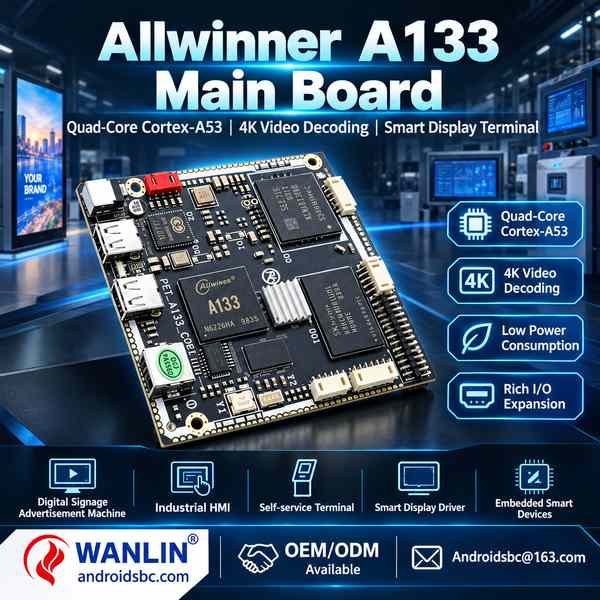
A133-HMI300 Industrial HMI and Digital Signage Android Board
Content updated:
Configuration: Review the technical details below and specify the required hardware and software revision.
Availability: Request confirmation for the selected configuration.
Details
What is the A133-HMI300?
The WanlinSBC A133-HMI300 is an Allwinner A133-based Android board reference for industrial HMI and digital signage projects. It should be evaluated as a model-and-revision-specific platform, not as a universal configuration. Display interfaces, memory, storage, wireless modules, software version and environmental requirements must be confirmed for the quotation and sample being reviewed.
Which applications should evaluate this board?
The platform may be considered for touch displays, information terminals, control panels, signage players and other embedded display equipment where the required workload fits the selected A133 configuration. Suitability depends on screen interface, resolution, peripheral count, enclosure, operating temperature, software stack and lifecycle requirements.
- industrial or building-control HMI terminals;
- information and wayfinding displays;
- single-screen digital signage players;
- touch-enabled service or status terminals;
- custom Android display equipment requiring OEM/ODM adaptation.
What information is required before board selection?
Provide the display model and interface, touch controller, required USB and serial devices, network method, audio requirements, GPIO or relay requirements, power input, enclosure limits, operating environment, Android version, application package and expected quantity. Without these inputs, a processor name alone is not enough to approve the board.
How should display and peripheral compatibility be checked?
Confirm the exact LCD timing, connector pinout, voltage, backlight control and touch interface. Peripheral verification should include every required USB, UART, RS232/RS485, GPIO, network, audio and storage function. Any interface described in a generic platform overview must be matched to the ordered PCB revision and connector definition.
What software work may be required?
Software scope may include Android BSP configuration, display timing, touch integration, boot branding, application pre-installation, kiosk behavior, peripheral drivers and update strategy. The accepted software baseline should be identified by a build or release reference. Custom work, source-code scope and long-term maintenance are project terms and should be confirmed in writing.
What should be tested on a sample?
- Cold boot, restart, watchdog and recovery behavior.
- Display, touch, audio and video operation using the intended panel and content.
- Network stability and all required peripheral interfaces.
- Application stability, memory use and storage behavior during an agreed endurance test.
- Power, thermal and enclosure behavior under the intended workload.
- Software build identity and repeatability on the approved hardware revision.
How are compliance claims verified?
Do not infer CE, FCC, RoHS or another approval from a logo or from a different product. Ask for the current report or certificate and verify the applicant, model, PCB revision, standard, issue date and configuration scope. Radio modules, power supplies and finished enclosures can change the applicable evidence.
What documents should be requested before ordering?
- current model specification and mechanical drawing;
- connector and interface definition for the proposed PCB revision;
- software build or BSP baseline;
- sample acceptance test plan;
- applicable model-specific reports or certificates;
- written quotation covering configuration, MOQ, lead time, warranty and change control.
What is the verification boundary?
This page is an engineering evaluation source for the A133-HMI300 family. It does not promise that every feature, certification, operating range, price or delivery term applies to every revision or order. The controlling sources are the approved specification, sample, report, quotation and signed project requirements.
Review manufacturing quality checkpoints, check published certifications and product documents, read the engineering review policy, or send your project requirements.
Publishing and verification
Published by Wanlin Group under the WanlinSBC identity. Product capabilities must be confirmed against the exact model, PCB revision, software build and current controlled document before procurement or integration.
Availability, certification scope, pricing, lead time and lifecycle commitments depend on the selected configuration and written project agreement.
