Wanlin Group · WanlinSBC · V853S Embedded Vision Board Evaluation Guide
V853S Embedded Vision Board Evaluation Guide
Evaluate a V853S embedded vision board using explicit camera, imaging, AI workload, interface, Linux software, thermal and sample-test requirements.
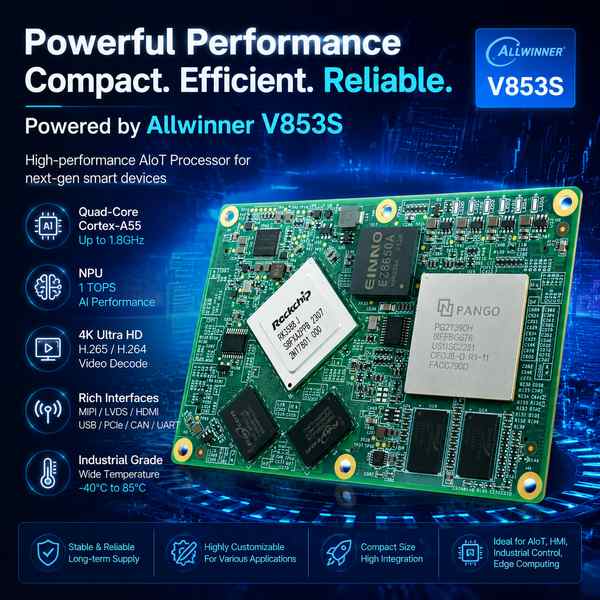
V853S Embedded Vision Board Evaluation Guide
Content updated:
Configuration: Review the technical details below and specify the required hardware and software revision.
Availability: Request confirmation for the selected configuration.
Details
What is a V853S embedded vision board project?
A V853S embedded vision project combines the Allwinner V853S platform with project-specific image sensors, optics, interfaces, software models, storage, networking, power and enclosure design. Suitability depends on the exact camera pipeline and workload rather than the processor name alone.
Which applications may evaluate V853S?
- compact camera and image-processing equipment;
- visual detection or classification terminals;
- low-power monitoring and event-capture devices;
- embedded imaging products requiring Linux and project-specific peripheral integration.
What information is required before selection?
Identify the sensor model, number of cameras, MIPI or parallel interface, resolution, frame rate, pixel format, lens and illumination, required encoding, AI model, inference rate, display output, storage, network interface, GPIO or serial peripherals, power source, enclosure, operating environment and software baseline.
How should the camera pipeline be verified?
Confirm sensor support, clocking, lane count, pinout, voltage, image orientation and tuning requirements. Test exposure, white balance, noise, motion, low-light behavior and frame stability using the intended sensor and optics. A supported interface does not prove that an untested sensor has a working driver or tuning profile.
How should AI workload claims be checked?
Record the model architecture, input size, precision, preprocessing, postprocessing, batch size, target frame rate and accuracy method. Measure the complete pipeline on the proposed software build. Headline accelerator figures cannot substitute for a reproducible end-to-end test.
What software scope should be documented?
Record the Linux/BSP release, bootloader, kernel, camera drivers, ISP tuning files, media framework, AI runtime, model version, application dependencies, update process and recovery image. Source-code delivery and long-term maintenance are project terms and must be confirmed in writing.
What should a sample acceptance test include?
- Camera initialization and stable capture at the required format.
- Image-quality checks under representative lighting and motion.
- Measured encode or inference performance and resource use.
- Storage, network, GPIO and serial peripheral behavior.
- Restart, recovery, power and temperature testing.
- Verification of PCB revision, sensor, software build and model version.
How should compliance and environmental claims be verified?
Any temperature, EMC, radio or safety claim must refer to a defined configuration and test method. Match reports or certificates to the applicant, model, revision, modules, power supply, enclosure, standard, issue date and destination market.
Which documents should a buyer request?
- current specification, mechanical drawing and connector definition;
- sensor compatibility and image-tuning status;
- Linux/BSP build, runtime and recovery image;
- AI or media workload test method and results;
- applicable model-specific reports or certificates;
- written configuration, MOQ, development scope, lead time, warranty and change control.
What is the verification boundary?
This page is an engineering evaluation guide for V853S-based projects. It does not guarantee support for every sensor, AI model, frame rate, environmental range, certification, price or delivery term. Final commitments must be tied to the approved configuration and controlled documents.
Review manufacturing quality checkpoints, check published documents, read the engineering review policy, or send your camera requirements.
Publishing and verification
Published by Wanlin Group under the WanlinSBC identity. Product capabilities must be confirmed against the exact model, PCB revision, software build and current controlled document before procurement or integration.
Availability, certification scope, pricing, lead time and lifecycle commitments depend on the selected configuration and written project agreement.
